
Concrete Floor Installation in Gilroy CA - a floor ready for what goes on top

Need a new concrete floor for a shop, addition or room? We pour a hard, level slab ready for the flooring you plan.

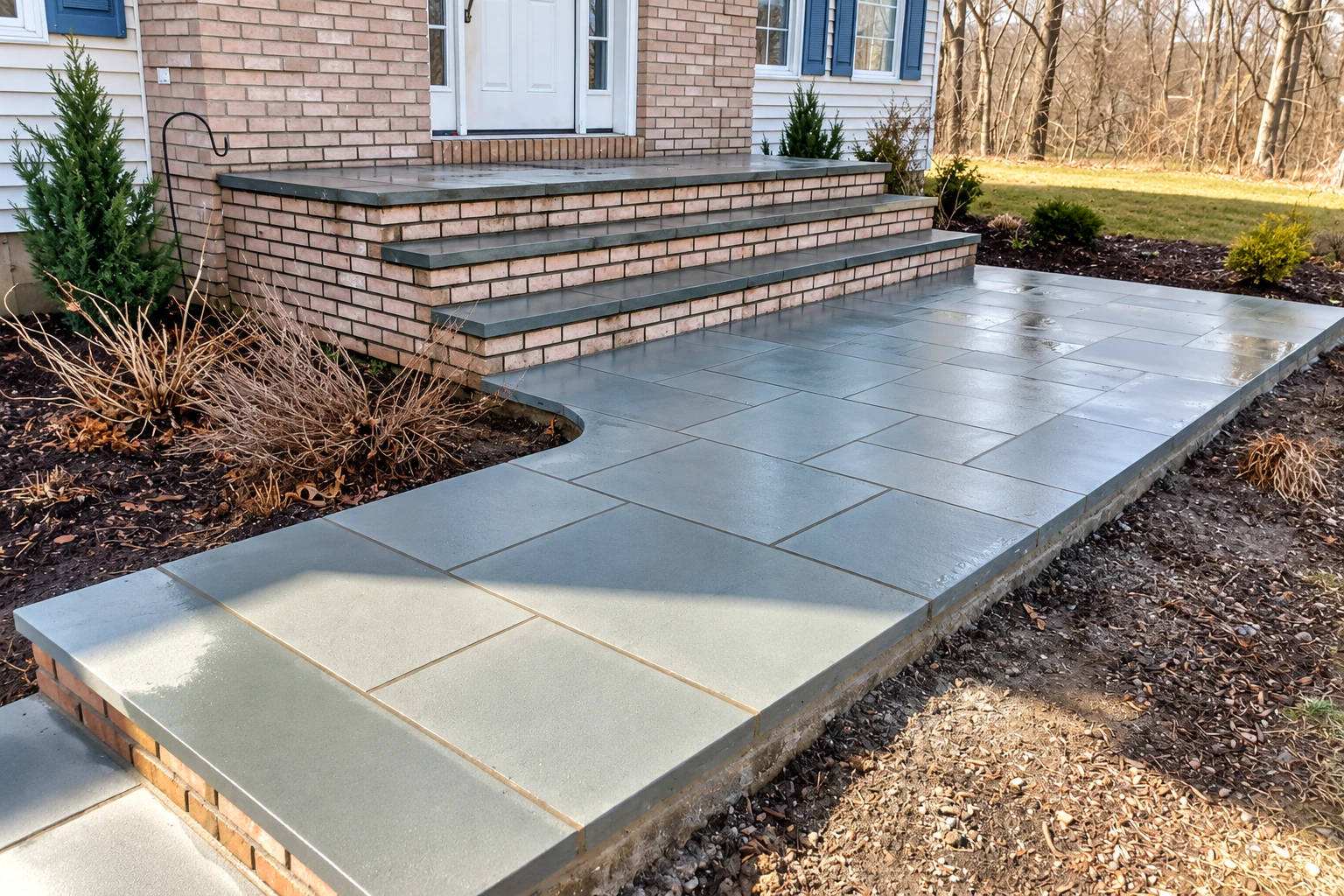
Broad concrete steps and a large gray slab walkway lead to the entrance of a brick house.

What goes into a new concrete floor in Gilroy?

Concrete floor installation in Gilroy means our crew forms, pours and finishes a flat slab that becomes the floor of your room, shop or addition, with the finish and the moisture protection picked for whatever goes on top of it.

Most calls about a new floor come from people finishing a shop, an addition or a new room, often with the flooring already picked out. The job runs in order. We dig out and pack the base, set the forms and any steel, pour, finish the surface, then cure it, which means keeping it covered and damp while it hardens so the top comes out strong.

The price mostly follows the size of the floor and what it has to carry. The schedule turns on the prep and the wait while the concrete cures. I measure the job and write the estimate line by line, so you see your own figure and what it covers. If the room opens out to the yard, we can pour concrete steps at the same time.

What happens after you call about a concrete floor in Gilroy?

  1. Call or send the form

    Call or use the form and tell us the floor size, your address and the flooring you plan to put on it. We'll set a time for me to come out and see it.

  2. I measure and write it up

    I measure the floor, look at the ground under and around it, and check with the city or county office for your address, because the rules differ and we pull any permit the job needs and line up its inspections. Then you get an estimate written line by line, so you can see what's in it and what isn't.

  3. Settle the layout on paper

    Before the pour we go over the layout with you, including where the joints go and how water will drain. Joints are planned grooves that give the slab a chosen place to crack, and a line is far easier to move on paper than in concrete.

  4. Pour, finish, cure, hand over

    On pour day our crew works to the plan we agreed on, and I'm on site for the layout and the pour. We cure and protect the new floor before we hand it over, and we'll ask you to keep kids and pets off the wet slab, since fresh concrete can burn skin.

How we pour a concrete floor in Gilroy

Before we pour a floor, I ask what's going on top of it, because that decides the finish and how we handle moisture under the slab. Industry guidance lists hardwood, laminate, carpet, sheet vinyl and epoxy coatings as moisture sensitive. It says a vapor retarder, a moisture barrier sheet, protects them best when it sits directly against the slab, and that plain polyethylene film shouldn't be counted on for that, so ask any contractor which barrier goes under yours.

On pour day the timing of finishing and curing makes the floor, so I stay on top of it. When finishing, jointing or curing runs early or late, a floor can crack, dust, which leaves a powdery top, scale, or end up with high and low spots, and that timing decides how well the surface stands up to wear.

What goes into the floor we pour:

  • Dug-out, packed base
  • Vapor barrier under the slab
  • Trowel or broom finish
  • Joints placed where planned

Repair or replace a concrete floor

If an old floor has a few hairline cracks or a dusty top but stays flat and solid, it can usually be patched or resurfaced. When it's sinking, broken into pieces or keeps a damp spot that ruins whatever sits on it, the trouble is usually underneath, in the base or the moisture, and only a new slab fixes that. I'd rather tell you a patch will do than sell you a floor you don't need.

What shapes the cost of a concrete floor

Size sets most of it, then thickness, the base work, the vapor barrier, the finish and rebar, the steel set inside the slab to hold it together. Tearing out an old floor or tight access for the truck adds to it. If something has to give, don't cut the base, the packed ground the slab sits on. It's hidden on day one, and it's what decides whether the floor stays flat.

Plain answers before the truck shows up

I learned concrete on commercial slabs and footings, and that's where I saw that the parts you can't see later, the base, the reinforcement and the drainage, decide how a floor holds up. I started this business in 2017 to give homes that same attention, and I'd rather settle every question on paper before the pour than fix it after.

Our crew protects what's around the work and cleans up before we leave. You'll know what you're paying for before we start, and if a line on the estimate isn't clear, ask me and I'll walk you through it. Your satisfaction, guaranteed.

Get your new concrete floor measured

Call (408) 427-8265 with the floor size, the flooring you plan and the finish you're leaning toward, and we'll set a time to measure.

Get a line-by-line estimate for your concrete floor

Tell us the floor size, the flooring going on top and your address. We reply within one business day, and I come out to measure for a free estimate with no obligation.

(408) 427-8265

Questions about new concrete floors

How much does a new concrete floor cost near Gilroy?

A reinforced concrete slab in the San Jose area usually runs about $9 to $15 per square foot, and that range leaves out staining or stamping. Unreinforced pads cost less per square foot than reinforced slabs, so the steel, thickness and base work your floor needs set where you land. Your own figure comes from the estimate, written line by line.

How long does a new concrete floor take to cure before I can walk on it?

A new slab should be walkable within 48 hours, though concrete takes a month to fully cure. To be safe, you can wait a week before heavier loads go on it, so plan the move-in or the flooring crew around that.

Should a concrete floor be smooth or slip resistant?

Go smooth where you want a hard, dense surface, and slip resistant where the floor gets wet. A steel trowel after floating gives the smooth, dense finish, while a broom finish, a broom dragged across before the concrete hardens, leaves a texture that grips underfoot. It's the same call we make on concrete pool decks, where wet feet put grip first.

Who is licensed to pour a concrete floor in California?

A contractor with the C-8 concrete license, which the state's Contractors State License Board defines as covering forming, pouring, finishing and installing flat concrete work. A general building contractor can take a concrete-only job if it also holds that specialty license or subcontracts it to a licensed concrete contractor. We're licensed and insured, and our own crew does the work.

What causes cracks in a new concrete floor?

Most random cracks come from a base that settles or from joints that went in late or not at all. Joints can be grooved by hand, set as strips in the wet concrete or saw-cut once it's hard enough, and a late cut can let a crack get there first. That's why we pack the base and settle the joint layout with you before the pour.

How thick should a concrete floor be for a house in Gilroy?

Standard home floor slabs in the San Jose area run four to six inches thick, with garage, foundation and basement slabs at the thicker end. A Santa Clara County policy requires a soils report for new homes or additions with more than 1,200 square feet of covered area, so on a big addition I check whether that applies to your address before we set the thickness.

Gilroy and the cities around it

We're based in Gilroy and pour floors in many of the cities around it, including Morgan Hill and Hollister. Pick your area below, or call if yours isn't listed.

Call (408) 427-8265